
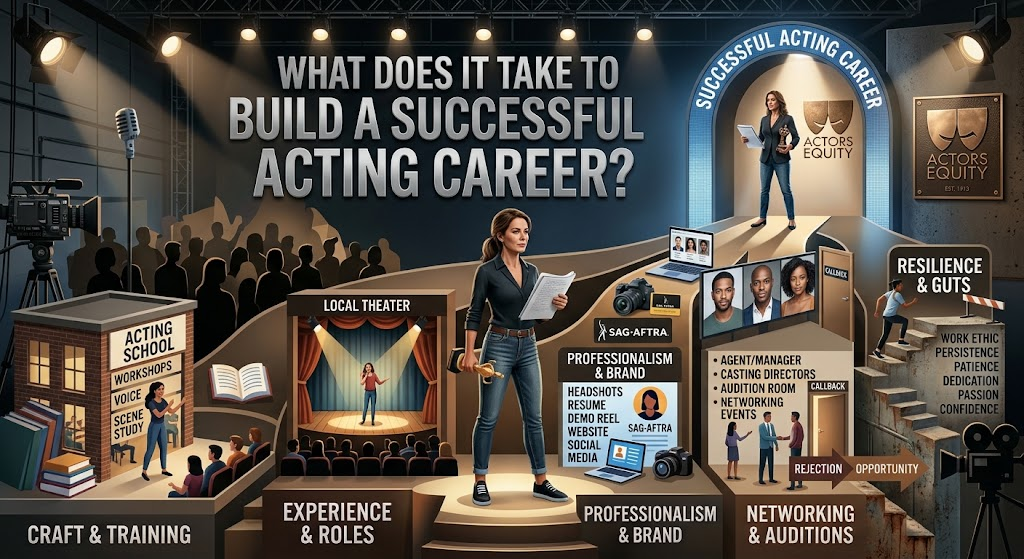
Building a successful acting career is a dream shared by thousands of aspiring performers. From films and television shows to theatre, commercials, streaming productions, and digital content, acting offers many exciting career opportunities. However, becoming a successful actor rarely happens overnight.
While natural talent is important, a successful acting career requires much more than the ability to perform. Professional training, audition experience, networking, personal branding, resilience, discipline, and continuous learning all play an important role.
So, what does it really take to build a successful acting career? Let’s explore the essential steps every aspiring actor should understand.
Table of Contents
Develop the Skills Needed for a Successful Acting Career
The foundation of every successful acting career is strong acting ability.
Some performers naturally have charisma, confidence, and emotional range. However, professional acting training can help transform natural talent into a dependable and versatile skill.
Acting classes, workshops, theatre productions, improvisation exercises, and scene studies can help performers become more confident and comfortable in different roles.
Actors should continuously develop skills such as:
- Emotional expression
- Voice and diction
- Body language
- Character development
- Improvisation
- Memorization
- Scene analysis
- Script interpretation
- Working with other performers
- Taking direction
Professional training also teaches actors how to respond to direction and adjust their performances based on what a director, producer, or casting professional needs.
The stronger your skills become, the better prepared you will be when important opportunities arise.
Build a Professional Acting Portfolio
A strong portfolio is another important part of building a successful acting career.
Casting professionals often see an actor’s materials before they meet them in person. Your portfolio therefore needs to create a professional first impression.
An acting portfolio should generally include:
- Professional headshots
- Updated acting résumé
- Showreel or demo reel
- Acting credits
- Relevant training
- Special skills
- Contact information
Your headshot should accurately represent your current appearance. Your résumé should clearly present your experience, training, credits, and relevant abilities.
A high-quality showreel can be especially valuable because it allows casting professionals to see your performance rather than simply reading about your experience.
As you gain new credits and experience, update your portfolio regularly. A professional and current portfolio can make it easier for casting teams to understand what you can offer.
Take Every Acting Audition Seriously
Auditions are one of the most important parts of an acting career.
Even experienced actors regularly audition for roles. For someone trying to build a successful acting career, learning how to audition effectively is essential.
Before an audition, carefully study the script and understand the character. Research the production when information is available and think about how you can bring something authentic to the role.
For self-tape auditions, technical quality also matters. Use clear lighting, good audio, appropriate framing, and a quiet environment so the performance remains the main focus.
Most importantly, don’t judge your progress only by the roles you book.
Every audition can help you improve your confidence, preparation, performance technique, and understanding of the casting process.
Understand How the Casting Process Works
Understanding how casting works can give actors an important advantage.
Casting professionals are looking for performers who fit the character while also bringing something authentic and interesting to the role. The actor selected may not always be the person with the most experience.
Sometimes casting decisions depend on factors such as:
- Character suitability
- Appearance
- Age range
- Performance style
- Chemistry with other actors
- Availability
- Production requirements
- Creative direction
This means rejection does not necessarily mean an actor performed poorly.
During auditions, focus on understanding the character and making confident choices rather than trying to become someone else.
Being prepared, punctual, professional, respectful, and receptive to direction can also help create a positive impression.
Build Meaningful Industry Relationships
Networking can play a major role in developing a successful acting career.
The entertainment industry is highly collaborative. Actors work with directors, producers, casting professionals, writers, cinematographers, photographers, fellow performers, and many other professionals.
You can build industry relationships through:
- Acting workshops
- Film festivals
- Theatre productions
- Independent film projects
- Industry events
- Acting communities
- Professional social media
- Filmmaking collaborations
However, effective networking isn’t simply about asking people for jobs.
Strong professional relationships develop through mutual respect, reliability, communication, and genuine interest in the industry.
An actor you work with on a small production today could recommend you for a larger opportunity in the future.
Create a Strong Personal Brand
Personal branding has become increasingly important for actors.
A professional online presence can help performers showcase their personality, creative work, performances, achievements, and professional experience.
Your personal brand should clearly communicate who you are as an actor and the types of roles or productions that suit you.
Consider maintaining professional profiles that include:
- Updated headshots
- Acting credits
- Showreel
- Professional biography
- Recent projects
- Contact information
- Relevant social media content
You don’t need to constantly promote yourself.
Instead, focus on creating an authentic and professional identity that casting professionals, filmmakers, and potential collaborators can easily understand.
A strong personal brand can support your successful acting career by making you more discoverable and memorable.
Gain Real Industry Experience
Experience is one of the most valuable assets an aspiring actor can develop.
Early opportunities may include:
- Student films
- Short films
- Independent movies
- Theatre productions
- Commercials
- Web series
- Voice-over projects
- Background roles
- Local productions
- Digital content
Not every project will lead directly to a major role. However, each experience can help you improve your craft, build confidence, expand your résumé, and meet other industry professionals.
The goal isn’t simply to collect acting credits.
Instead, focus on learning from every production and developing a body of work that demonstrates your abilities.
For many performers, smaller projects become important stepping stones toward a successful acting career.
Learn How to Handle Rejection
Rejection is one of the biggest challenges actors face.
You may deliver an excellent audition and still not receive the role. The decision could depend on factors completely outside your control.
Casting decisions can be influenced by:
- Production requirements
- Character appearance
- Age
- Chemistry
- Scheduling
- Budget
- Location
- Creative direction
- Availability
Understanding this can make rejection easier to manage.
Instead of viewing every unsuccessful audition as a failure, use it as an opportunity to learn.
Ask yourself:
What can I improve before my next audition?
Developing resilience is essential because a successful acting career often involves many auditions, setbacks, and unexpected opportunities.
Maintain Professionalism on Every Production
Talent may help an actor get noticed, but professionalism can help build a lasting reputation.
Being professional means:
- Arriving on time
- Knowing your lines
- Preparing before rehearsals
- Respecting the crew
- Listening to direction
- Communicating clearly
- Maintaining a positive attitude
- Respecting schedules
- Taking your responsibilities seriously
Film and television productions involve large teams. Directors and producers want performers who can deliver strong performances while also contributing positively to the working environment.
Your reputation can become one of your most valuable career assets.
A professional actor may be recommended for future projects simply because directors and producers know they are reliable.
Continue Learning Throughout Your Acting Career
The entertainment industry continues to evolve.
Streaming services, digital productions, self-tape auditions, social media, and new forms of entertainment are creating different opportunities for performers.
Actors should therefore continue learning throughout their careers.
You can improve by:
- Taking acting classes
- Studying professional performances
- Reading scripts
- Watching different genres of film
- Practicing improvisation
- Attending workshops
- Learning about filmmaking
- Studying character development
- Working with other performers
The strongest actors understand that there is always something new to learn.
Continuous improvement can help you remain competitive and prepared for future opportunities.
Develop a Long-Term Career Strategy
A successful acting career is rarely built within a few months.
There may be periods when you receive multiple auditions and exciting opportunities. There may also be times when opportunities seem limited.
This is why actors should develop a long-term strategy rather than focusing exclusively on their next role.
Set realistic goals for different stages of your career.
For example, your goals could include:
- Completing professional acting training.
- Creating professional headshots.
- Building a strong showreel.
- Auditioning consistently.
- Gaining independent film or theatre experience.
- Building industry relationships.
- Developing a professional online presence.
- Expanding your acting range.
- Securing larger and more challenging roles.
Small, consistent steps can eventually create significant progress.
Be Patient and Stay Consistent
Patience is one of the most important qualities for anyone pursuing acting.
The entertainment industry can be unpredictable. Some actors achieve recognition quickly, while others spend years developing their careers before receiving a major opportunity.
Comparing your journey with another actor’s career can create unnecessary frustration.
Instead, focus on your own progress.
Continue training, auditioning, networking, gaining experience, improving your portfolio, and learning from every opportunity.
Consistency can create momentum and keep you prepared when the right role arrives.
Use Every Opportunity to Improve Your Craft
Every performance can teach you something.
Whether you’re working on a student film, theatre production, commercial, independent movie, or major production, pay attention to what you learn.
Think about:
- How you prepared
- How you worked with the director
- How you developed the character
- How you handled pressure
- How you interacted with other performers
- What you would improve next time
This mindset can help transform individual projects into long-term professional development.
A successful acting career is built through accumulated experience rather than a single breakthrough.
What Makes an Actor Stand Out?
There is no single quality that guarantees success in acting.
However, several characteristics can help performers stand out:
- Strong acting skills
- Authenticity
- Preparation
- Professionalism
- Adaptability
- Emotional intelligence
- Confidence
- Resilience
- Communication
- Continuous learning
An actor who combines talent with professionalism and determination can create more opportunities over time.
Frequently Asked Questions About Building a Successful Acting Career
How do I start a successful acting career?
Start by developing your acting skills through training and practice. Build professional headshots, a résumé, and a showreel, then gain experience through auditions, theatre, independent productions, and other legitimate opportunities.
Do I need professional acting training?
Professional training isn’t the only path into acting, but classes and workshops can help improve technique, confidence, voice, movement, character development, and audition skills.
How important are auditions to an acting career?
Auditions are extremely important because they allow casting professionals to evaluate performers for specific roles. Learning how to prepare and perform effectively during auditions can significantly improve your opportunities.
How long does it take to build a successful acting career?
There is no fixed timeline. Every actor’s journey is different. Building a successful acting career can take years of training, experience, networking, auditions, and persistence.
Is networking important for actors?
Yes. Acting is a collaborative industry, and professional relationships can lead to recommendations, auditions, collaborations, and future opportunities.
How can actors deal with rejection?
Actors should understand that casting decisions involve many factors. Treat rejection as part of the profession, learn from each audition, continue improving, and remain focused on long-term goals.
Can independent films help an acting career?
Yes. Independent films can provide valuable acting experience, portfolio material, professional connections, and opportunities to work with filmmakers and other performers.
Final Thoughts
Building a successful acting career requires much more than natural talent. Training, auditions, experience, networking, professionalism, personal branding, resilience, and continuous learning all contribute to long-term growth.
There is no universal formula for becoming a successful actor. Every performer follows a different path, and opportunities can come from unexpected places.
The most important thing is to keep developing your craft, prepare seriously for every opportunity, build meaningful professional relationships, and remain persistent when things don’t go according to plan.
With patience, dedication, professionalism, and consistent effort, every audition, performance, and industry connection can become another step toward a successful acting career.