
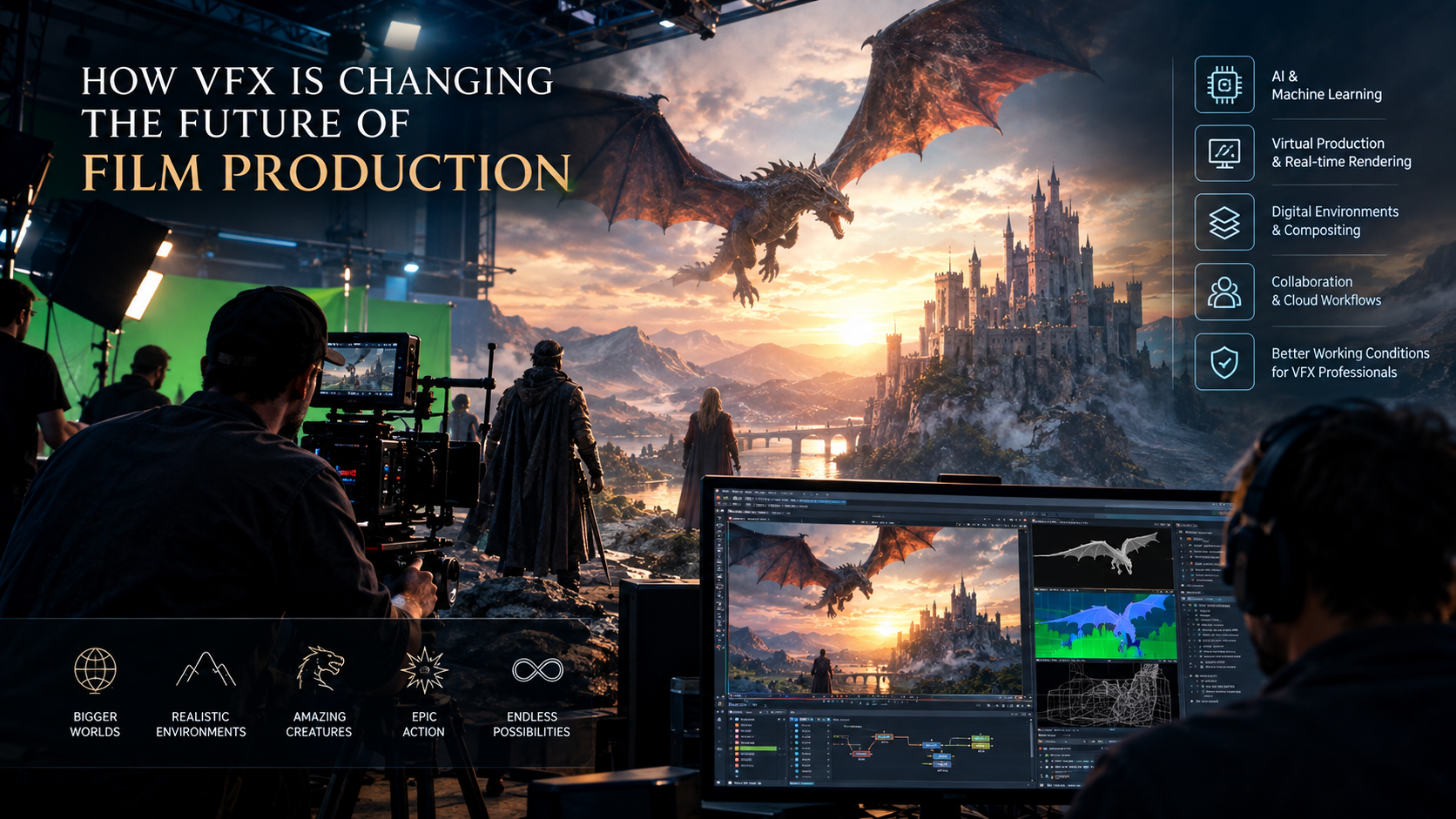
Visual effects have become one of the most important parts of modern filmmaking. From creating enormous fantasy worlds to enhancing realistic environments, VFX in film production allows filmmakers to tell stories that would be difficult, expensive, or sometimes impossible to capture entirely with a traditional camera.
Today, VFX in film production is no longer limited to blockbuster science-fiction and fantasy movies. Visual effects are used across action films, dramas, television series, commercials, music videos, and streaming productions. As technology continues to develop, the way filmmakers plan, create, and deliver visual effects is changing rapidly.
Artificial intelligence, virtual production, real-time rendering, digital environments, cloud-based collaboration, and advanced compositing are all influencing modern filmmaking. At the same time, developments involving VFX professionals have brought greater attention to wages, benefits, working hours, safety, and artificial intelligence protections.
Understanding these changes is increasingly important for film production companies that want to use visual effects effectively while maintaining a strong creative and production workflow.
Table of Contents
Why VFX Has Become Essential to Modern Filmmaking
The role of VFX in film production has expanded significantly. Visual effects are now used to enhance both large-scale productions and smaller projects, often without audiences realizing how much digital work has been added to a scene.
Production teams use visual effects to:
- Create digital environments and locations
- Extend physical sets
- Build fictional characters and creatures
- Enhance action sequences
- Remove unwanted objects from footage
- Improve lighting and backgrounds
- Create realistic explosions and environmental effects
- Combine practical footage with computer-generated imagery
- Create digital crowds and background elements
- Enhance locations that are difficult to film practically
This flexibility gives filmmakers greater creative control while helping productions achieve visual results without relying entirely on expensive physical sets, locations, or practical effects.
Modern visual effects in filmmaking can also make it possible to modify a scene after principal photography. A background can be replaced, an object can be removed, or an environment can be expanded without reshooting the entire sequence.
The Growing Importance of VFX Professionals
Behind every successful visual effect is a team of artists, coordinators, supervisors, technicians, and other production professionals.
As VFX in film production has become increasingly important, discussions about the working conditions of VFX professionals have also gained greater attention. Visual effects require specialized creative and technical skills, and many productions depend on these professionals throughout different stages of filmmaking.
Recent industry developments involving IATSE have highlighted negotiations and workplace standards affecting VFX workers. These discussions have included areas such as minimum rates, healthcare, retirement benefits, overtime, rest periods, workplace safety, and protections related to artificial intelligence.
This development reflects the growing recognition of VFX as an essential craft within modern film and television production.
For production companies, this also demonstrates why successful VFX workflows require more than software and hardware. Skilled professionals, effective communication, realistic schedules, and appropriate production planning remain important parts of delivering high-quality visual effects.
AI Is Changing the Future of VFX
Artificial intelligence is becoming another major factor influencing the future of visual effects.
AI and machine-learning technologies can assist with tasks involving image processing, compositing, asset creation, editing workflows, and other technical processes. These tools may help artists automate repetitive work and explore creative possibilities more efficiently.
However, the growing use of AI also raises important questions about creative control, employment, consent, intellectual property, training, and the role of human artists.
IATSE’s existing AI provisions, for example, address issues including the use of AI systems by employees, training, employee displacement, scanning, and potential effects of AI implementation on workers.
This means the future of VFX in film production is unlikely to be simply about choosing between human artists and AI. Instead, production companies will increasingly need to consider how emerging technologies can be integrated into existing workflows while maintaining clear responsibilities and protecting creative professionals.
AI may become an important tool within the VFX pipeline, but creative direction, storytelling, artistic judgment, and production decision-making will continue to influence the final result.
VFX Workflows Are Becoming More Technology-Driven
Modern VFX in film production involves much more than traditional post-production.
Virtual production, real-time rendering, digital environments, motion capture, advanced compositing, 3D modeling, and cloud-based collaboration are changing how filmmakers approach visual storytelling.
Virtual production can allow filmmakers to visualize environments and scenes earlier in the production process. Real-time graphics can provide immediate visual feedback, while digital environments can reduce the need to travel to multiple physical locations.
These technologies can help creative teams:
- Visualize scenes before filming
- Test environments and camera angles
- Make creative decisions earlier
- Reduce unnecessary production changes
- Collaborate across different locations
- Improve communication between departments
- Integrate visual effects earlier in the filmmaking process
For production companies, understanding these film production technology trends can help create a more organized pipeline from pre-production through post-production.
What This Means for Film Production Companies
The evolution of VFX in film production creates new creative opportunities as well as new production challenges.
Film production companies need to consider several factors when planning visual effects.
1. Plan VFX During Pre-Production
Visual effects should not always be treated as something added after filming.
Identifying VFX requirements during pre-production can help directors, cinematographers, producers, and VFX teams coordinate their work from the beginning.
A detailed VFX plan can identify which scenes require CGI, environment extensions, compositing, motion capture, green screens, practical effects, or other techniques.
Early planning can also help production teams understand budgets, schedules, technical requirements, and potential challenges before cameras begin rolling.
2. Combine Practical and Digital Effects
The most effective productions can combine practical filmmaking with digital technology.
Physical sets, props, makeup, lighting, costumes, and performances can provide a strong foundation that VFX teams enhance during post-production.
This combination can create more convincing results because digital effects do not necessarily need to replace practical filmmaking. Instead, visual effects in filmmaking can enhance what was captured on set.
3. Choose Technology Based on the Story
New technology can be impressive, but technology should support the story rather than distract from it.
A successful VFX workflow starts with understanding what a scene requires and then selecting the appropriate tools and techniques.
Not every production needs the latest AI system, virtual production stage, or complex CGI pipeline. The right technology depends on the project’s creative requirements, budget, schedule, and visual goals.
4. Build Strong Collaboration Between Departments
VFX involves multiple stages of production. Directors, producers, cinematographers, editors, VFX supervisors, artists, and other specialists need to communicate throughout the process.
Strong collaboration can reduce unnecessary revisions and help maintain consistency across the finished project.
When VFX teams are involved early, they can provide technical input before production decisions become difficult or expensive to change.
5. Consider VFX During Budget Planning
Visual effects can involve significant costs depending on the complexity of a project.
Production companies should consider VFX requirements when developing the initial budget rather than treating them as an unexpected post-production expense.
Planning for artists, software, rendering, compositing, revisions, and delivery requirements can help create more realistic expectations for the production team.
VFX Industry Trends to Watch
Several VFX industry trends are likely to influence filmmaking in the coming years.
Artificial Intelligence
AI-assisted tools may continue to automate repetitive tasks and support artists with image processing, asset creation, and other workflow requirements.
Virtual Production
Virtual production and real-time rendering are allowing filmmakers to make visual decisions earlier while combining physical performances with digital environments.
Cloud-Based Collaboration
Cloud technology can allow VFX teams and production departments to collaborate across different locations, making remote and international workflows easier to manage.
Real-Time Rendering
Real-time graphics technology can provide filmmakers with faster visual feedback and allow creative teams to make decisions without waiting for lengthy rendering processes.
Greater Integration Between Production Stages
The traditional separation between pre-production, production, and post-production is becoming less distinct. Modern VFX in film production can influence creative decisions from the earliest planning stages through final delivery.
The Future of VFX in Film Production
The future of VFX in film production will likely combine increasingly sophisticated technology with highly skilled creative professionals.
AI, real-time graphics, virtual production, digital environments, and other emerging technologies may continue to change established workflows. Meanwhile, developments involving VFX labor agreements demonstrate that the conversation around the industry also includes the people responsible for creating these visual experiences.
For filmmakers, the goal is not simply to use the newest technology. The real opportunity is to understand how technology, creativity, production planning, and skilled talent can work together.
As audiences become accustomed to increasingly detailed visual experiences, VFX in film production will continue to play an important role in shaping the future of film and television.
Production companies that understand these changes can make more informed decisions about their visual effects pipelines, technology investments, creative processes, and collaboration with VFX professionals.
Final Thoughts
The evolution of VFX in film production represents a broader transformation in filmmaking. Technology is giving production teams new creative possibilities, while VFX professionals are becoming increasingly recognized as an important part of the production process.
For film production companies, staying informed about VFX developments, AI, virtual production, and modern workflows can help them approach projects with greater creative and technical flexibility.
At Lux Productions, understanding the relationship between storytelling, production, and emerging technology is essential to creating compelling screen experiences. As filmmaking continues to evolve, VFX in film production will remain an important tool for turning ambitious creative ideas into finished productions.
The future of visual effects will not be defined by technology alone. The combination of creative vision, skilled professionals, effective planning, and innovative production tools will continue to shape how stories are brought to life on screen.